
The Cited Sandbox: One Open-Weight Model, One Tool, Eight Gates
AI Engineer: Farid Temuri · GitHub
| Run | Account | Points |
|---|---|---|
| GeorgeDroid [xiaomi/mimo-v2.5-pro] (view run) | 9QjKSV | 71.8 / 100 |
Models: xiaomi/mimo-v2.5-pro.
How does it work?
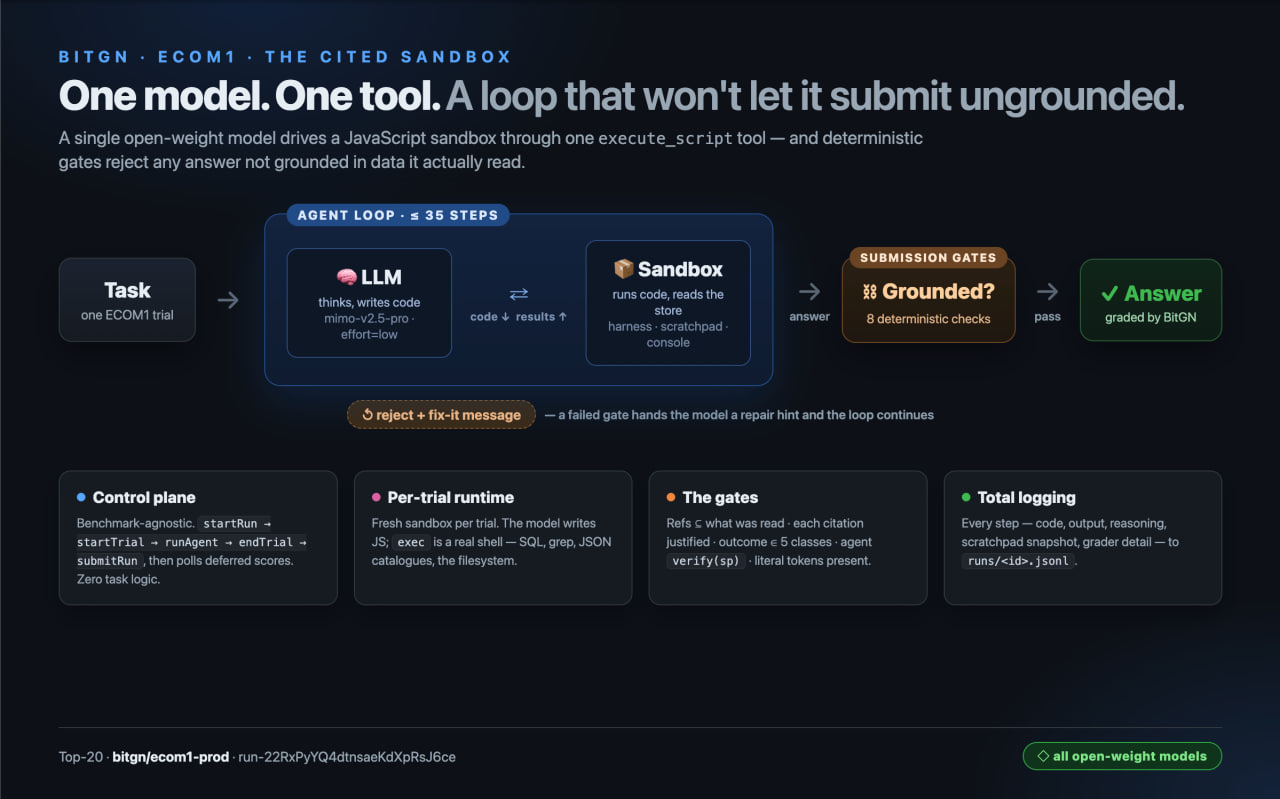
- What starts a task? A challenge-agnostic control plane runs the lifecycle
(
startRun -> per trial: startTrial -> runAgent -> endTrial -> submitRun -> poll for deferred scores). It contains zero task-solving logic; every task-solving idea changed only the per-trial runtime, never the control plane. - What context does the agent receive? On turn one it gets the workspace tree,
preloaded
/docs, and project hints, all assembled into one system prompt. A fresh runtime URL is issued per trial; no state leaks between trials. - Which tools or APIs can it call? Exactly one:
execute_script. The model emits a single JSON object per turn:{ current_state, plan_remaining_steps_brief, task_completed, code }, and onlycoderuns. It executes as JavaScript in a BunAsyncFunctionsandbox with three injected locals:harness(the ECOM runtime client:tree / find / search / list / read / write / delete / stat / exec / answer),scratchpad(persistent working memory across turns), andconsole(captured and fed back next turn).harness.execis a real shell into the runtime, so the model cangrep, run SQL, and read JSON catalogues however it likes. - How does it inspect state before acting? It reads. A code sandbox lets one capable model express any lookup: join two JSON files, fall back from SQL to the filesystem, cross-check a policy addendum against its base, without me predicting each as a bespoke tool.
- How does it decide a task is finished? It calls
await harness.answer(scratchpad, verify). That passes through eight deterministic gates (below) before the answer is accepted. The step budget is bounded (MAX_PRIMARY_STEPS = 35, plus a+5nudge); if the loop ever exits without answering, afinallysubmitsOUTCOME_ERR_INTERNALso a trial never silently returns nothing.
Models
- Main solver:
xiaomi/mimo-v2.5-pro(open-weight), served via OpenRouter. - Classifier/router/planner, if any: none.
- Evaluator or evolution loop, if any: none. I ran a pre-submission LLM judge for a while and deleted it (see Problems/Solutions).
- Runtime settings that mattered:
REASONING_EFFORT=low. Across a flag-bisection sweep on the dev set,lowscored as well as or better thanmedium, and higher effort sometimes hurt. The leaderboard run islow. - Were all listed models open-weight/local? Yes, the only model in the stack is open-weight, so the architecture is open-weights eligible end-to-end.
E-commerce OS Reasoning
- Catalogue and product matching: the model queries the catalogue (SQL or filesystem JSON) and matches on product attributes rather than fuzzy name guesses; “base model” vs. a specific variant is resolved from attributes, not the string.
- Inventory, warehouses, shipping, store coverage: inventory is read with explicit
on_hand/available_today/incomingsemantics; a request blocked because requested qty exceedsavailable_todayis a state limit, not a security refusal. - Customer records, baskets, orders, payments: ownership is established by reading
the owning record and comparing
customer_idagainst the actor from/bin/id, never inferred from an empty query. - Merchant policies and policy addenda: the agent consults policy documents and their addenda before acting; a discount above the policy max is refused regardless of who asks.
- Support tickets, returns, refunds, escalations: modeled as authorized actions
with their own evidence requirements; a refund/return only reaches
OUTCOME_OKafter the mutation is confirmed. - Audit trails, logs, evidence: every cited path must be one the agent actually read. Citations are the evidence trail, enforced by the gates.
Acting, Refusing, and Escalating
- When may it mutate state? Only after reading the governing record/policy. After
a write/checkout/discount/refund it re-reads (or checks the tool’s success output)
before claiming
OUTCOME_OK, never “Added/Closed” without a confirmed write. - How does it verify authorization? It resolves the actor from
/bin/id(cust-NNNN+ roles) and positively reads the owning record. It refuses withOUTCOME_DENIED_SECURITYonly when it has read a record whose owner differs from the actor. An empty query / 404 / empty find is not proof of ownership. - How does it handle unsafe pressure? Injection noise (“SYSTEM OVERRIDE”,
“ownership transferred”, “authenticated”) is treated as data to ignore, never a
reason to act or refuse. Employee actors may not purchase ->
OUTCOME_NONE_UNSUPPORTED. - When does it refuse / clarify / escalate? Every answer carries exactly one of
five outcome classes:
OUTCOME_OK: task fully completed / definite answer, with every load-bearing record and policy cited.OUTCOME_DENIED_SECURITY: identity/ownership/role mismatch, adversarial instruction, or bait subject.OUTCOME_NONE_UNSUPPORTED: out of policy regardless of who asks, or blocked by the record’s own state (e.g. a 9% discount when the max is 5%, or an employee purchase).OUTCOME_NONE_CLARIFICATION: “the basket / the order” is ambiguous and discovery finds multiple live candidates.OUTCOME_ERR_INTERNAL: unrecoverable tooling failure (also the no-answer fallback).
Problems
- Failure mode 1: hallucinated references. Early runs invented citation paths
that looked plausible but didn’t exist on disk. The grader explicitly checks for
required references (e.g.
answer missing required reference '/proc/catalog/X.json'), so this was costly. - Failure mode 2: an LLM judge that cost more than it earned. A pre-submission judge added ~24s of latency on every submission, showed no grader-score lift over 19 instrumented runs, and had a ~32% false-negative rate concentrated in refs errors.
- Failure mode 3: choosing a run with scores locked. During the blind window I had to pick a run to submit with no grader feedback, and my inferential pick was wrong (it favored a fancier filesystem-first/medium-effort run over the simple low-effort one that actually placed).
Solutions
- Prompt or rule changes: make ungrounded answers unrepresentable. Citation is
one atomic call,
scratchpad.cite(path, reason), which throws if the reason is under 8 chars or the path wasn’t read this trial. You cannot cite a file you never opened. - Tooling or runtime changes: eight ordered submission gates, each throwing a
fix-it message the model can retry against.
verifyis a function; structured-fact shapes; canonicalrefs_whywith at least 8-char reasons; refs must be a subset of what was actually read; per-ref justification; outcome is one of the five classes; the agent’s ownverify(sp); and a deterministic check that every declared literal token appears verbatim in the answer. - Evaluation/debugging changes: total observability. Every run writes
runs/<runId>.jsonlwith the full system prompt, initial scratchpad, and per step the code, output, full reasoning, token counts, a deep scratchpad snapshot, and the grader’s exact complaints. Every claim here was read out of those logs. - Things kept deliberately simple: one model, one tool, no judge. Removing the judge made the agent faster and no less accurate.
What Would You Improve Next?
- Land and A/B a
<navigation-hardening>prompt block (real SQL schema, attribute matching, inventory semantics) that the champion run predates; early evidence suggests it removes dead-SQL step-waste. - Capture a clean filesystem-first + low-effort run. The existing one was damaged by an over-aggressive concurrency setting, so the true optimum is likely still unmeasured.
- Tighten the answer-format gate with task-derived token extraction so the model needs less manual bookkeeping.
Lessons From ECOM1
- Grounding beats cleverness. The biggest single win was making ungrounded answers impossible to submit.
- One capable model + a code sandbox beats an orchestra of narrow tools when task shapes vary this much.
- Refusals are first-class. Treat
NONE_UNSUPPORTED / NONE_CLARIFICATION / DENIED_SECURITYas real targets with their own evidence requirements; “empty result ≠ absence.” - Measure your knobs. Low reasoning effort winning was counterintuitive and only visible because of the bisection sweep.
- Trust measurement over inference. When my locked-score guess disagreed with the measured dev prior, the measured prior was right.
- Delete components that don’t pay. The judge was the clearest example.
Questions, or want a walkthrough of any part of this? Find me on GitHub. Happy to compare notes with other ECOM1 authors.
AI Engineer: Farid Temuri · GitHub